Tuesday, 10 October 2017

NEWTON MENDONÇA

Newton Ferreira de Mendonça was born on 14 February 1927, in Rio de Janeiro. He was an Aquarian just like Antonio Carlos Jobim, his best friend, born on 25 February 1927, only 20 days earlier. 

He lived in Porto Alegre-RS and was back in Rio in 1942, when he was 15 years old. He was a classic-trained pianist and joined his childhood friend Tom Jobim circa 1953. They wrote both music and lyrics for seminal songs like 'Desafinado', 'Samba de uma nota só', 'Discussão', 'Meditação' aka 'O amor, o sorriso e a flor' and others.

As his friend Jobim, Newton played piano at night clubs in Rio which was not good for his health. He had a heart attack in 1959, while working at Carrossel. A year later, on 22nd November 1960, Newton had a second and fatal heart attack.

Newton Mendonça was a shy type of entertainer. He avoided the spotlight but somehow received Radiolandia's journalist at his home in October 1960 for a chat. Exactly 4 weeks before he died.

Newton Mendonça at his piano at home. Radiolandia #337, 15 October 1960. 
Renato (4 years-old), Cirene his missus, Fernando (1 year-old) & Newton (33 years-old).
Radiolandia #343, 1st January 1961; Newton Mendonça died on 22nd November 1960. 
a simple note at 'Correio da Manhã', 24 November 1960, says Newton Mendonça died in the first hours of the day. Newton had played piano at a night club and had arrived home. He went to the kitchen to prepare a light meal and get to sleep. Suddenly he felt a sharp pain in his chest and it was Death itself which came to fetch him. 
most of Newton Mendonça's photos available publicly were taken a few weeks before his death.
Cirene holds Fernando & Newton holds Renato - 1960. 
an earlier photo of Mendonça's.

Wednesday, 20 September 2017

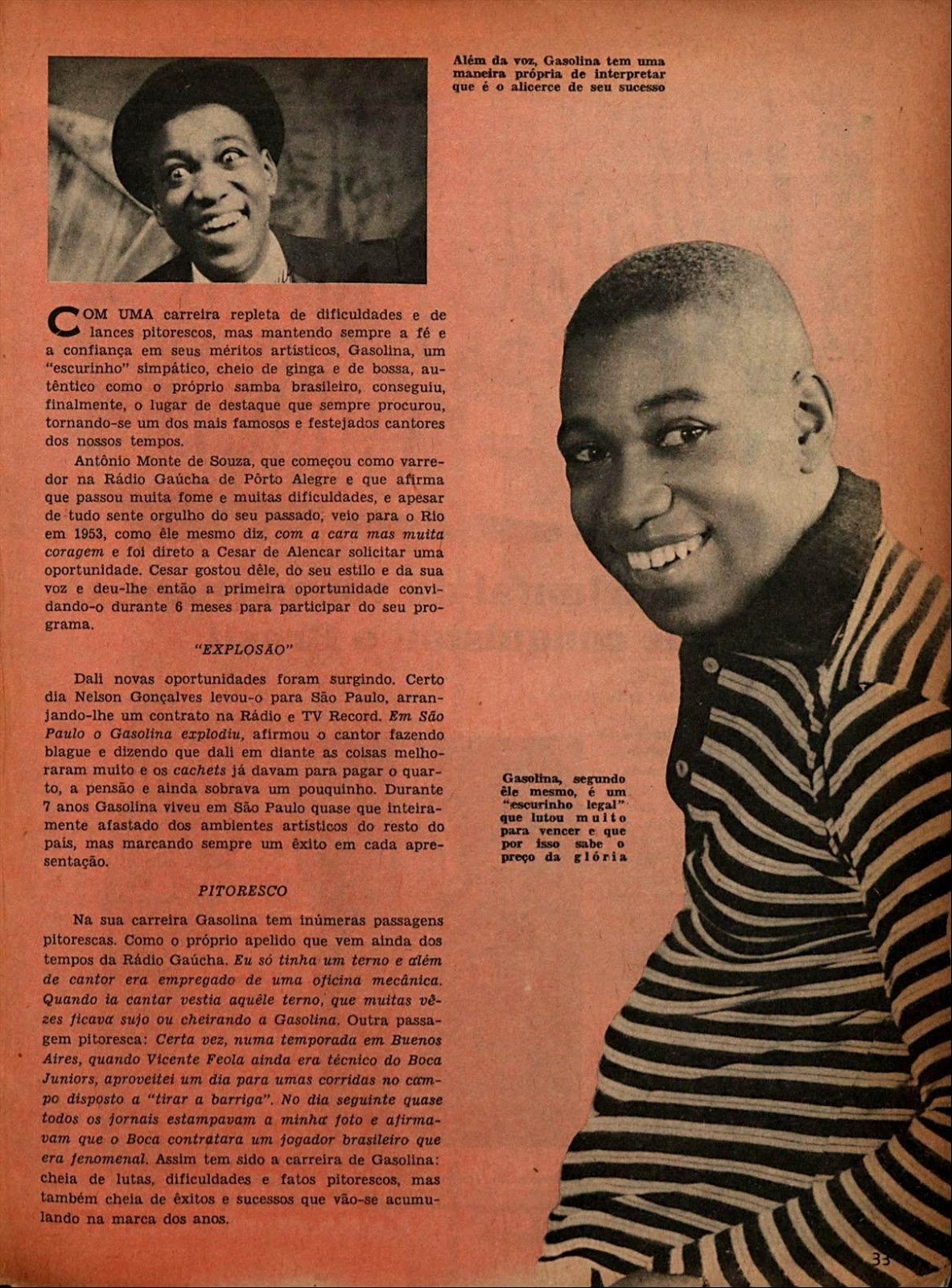
GASOLINA, young & Black / NOITE ILUSTRADA & racism in Brazilian society

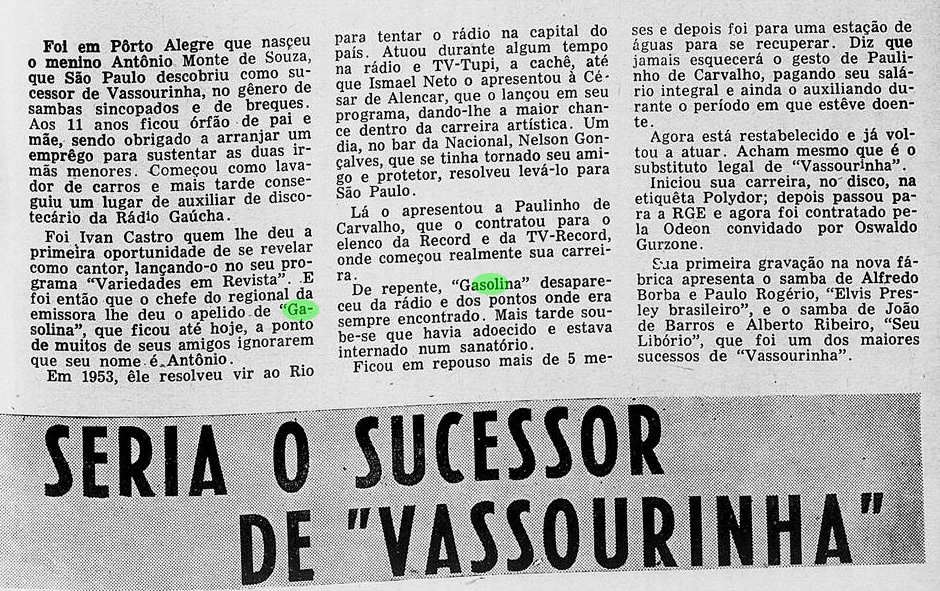
Antonio Monte de Souza used to work at a gasoline station in Porto Alegre-RS. After knocking off work he would change into a nice suit and go off to Radio Gaúcha to sing at gong shows. People noticed that his clothes reeked of gasoline and that's how he got his nickname. 

In 1953, Antonio up and left Porto Alegre to try his luck in Rio de Janeiro. He went straight to Radio Nacional and asked MC Cesar de Alencar for a chance to sing. 

Nelson Gonçalves took a shine to Antonio and brought him to Sao Paulo where he signed with Radio Record for 7 years.
'Radiolandia' 15 August 1963.

'Caminho diferente' (Zé Keti) / 'Vou parar de falar' (Geraldo Serafim-Erasmo Silva) Odeon (1958)

17.792 - Continental 1960 - Escureceu (Talismã-Edmundo Andrade) / Castigou legal (Nancy Wanderley-Newton Ramalho)

Radiolandia #338,  15 October 1960.

Brazilian press usually treated Black people with contempt and derision. This little article on Radiolandia says Gasolina was really thankful to Paulinho Machado de Carvalho the strong-man at Radio & TV Record for having literally saved him from starvation when he signed him up as a singer. 

The magazine goes a little farther on the sterotyping saying Gazolina said: 'I am the poor man's Sammy Davis, Jr. But I assure you I won't be marrying a blonde woman'.  Gazolina meant May Britt the Swedish blonde who married the Black US entertainer.
8 April 1960 - At Rio's Plaza Boite, Gasolina stars with Claudia Moreno in the revue 'Bossas da Velha Cap' two weeks before Brasilia would be inaugurated...
Radiolandia #345; Gasolina & Angela Maria in 1961. 
Radiolandia #359; Paulo Molin & Gasolina in 1961.
Intervalo posted this Gasolina photo as late as 21st July 1963, when he took part in a charity show organized by Rio de Janeiro Archbishop Dom Helder Câmara.

this is the first ever Gasolina photograph at 'Revista do Radio' (1957).
 'Revista do Radio' no. 413 shows Gasolina, the 'new kid in town' in 1957.
Luely Figueiró & Gasolina - 'Revista do Radio' n. 469.
'Revista do Radio' n.470 (1958) shows Gasolina and the 'Gaucho connection' (performers originally from Rio Grande do Sul (the Southern-most state in Brazil) who migrated to Rio de Janeiro, then Brazil's capital. They were roughly: Nelson Gonçalves, Luely Figueiró, Julio Rosemberg, Amilton Fernandes, Alberto & Paulo Ruschel.
more about the 'Gaucho connection' on 'Revista do Radio' n.470.
Gasolina, N.I. lady, Paulo Augusto (?), Amilton Fernandes, Julio Rosemberg, Wilson Roberto and ?
Johnny Ray, the Prince of Wails confabulates with Gasolina. 'Revista do Radio' n. 488.
 'Revista do Radio' n.512 brings Gasolina's few biographical data; his DOB is actually 23 January 1937; 
'Revista do Radio' n. 611 - 1961.
Gasolina in Buenos Aires in the winter of 1961, with Lona Waren serving him a chimarron; on the right photo Gasolina wear a tuxedo by the side of Spanish bomshell Rosa Morena - 'Revista do Radio' n. 633.
Gasolina devours an Argentine empanada... 

Noite Ilustrada and racism in Brazilian society 

Noite Ilustrada (Illustrated Night) was singer Mario Filho's pseudonym. As various Black entertainers before him, he was given a racist-tinged name relating to his dark skin. 

Brazilian society has been a racist society since the 17th century when the Portuguese promoted the African slave traffic that dominated Western society for centuries. 

Well, we're still racist with different shades & forms...

This 1962 Radiolandia articles says: A singer who needs to change his name! 

Radiolandia #367, 1st January 1962. 
Noite Ilustrada's 1961 album released by Mocambo.

Sunday, 6 August 2017

Renata & Cesar travel the world 1951

'Jornal das Moças' journalist Suzy visits Renata Fronzi at her apartment in Copacabana, and talks about her trip to the USA & Europe; Renata & husband Cesar Ladeira travelled during the last two months of 1951, before she has another baby. 

'Jornal das Moças' interview Renata Fronzi who shows photos she took during her worldwide travel. 
'Jornal das Moças', 3rd January 1952; the couple visited Xochimilco in Mexico, Los Angeles, California, New York. Then they flew to London and Paris. 
Renata Fronzi on Broadway. 'David & Bathsheba' premiered on 10 August 1951, starring Gregory Peck & Susan Hayward. By the looks of Fronzi's clothes this would be November 1951.

Renata went to see Ethel Merman & Paul Lukas in Irving Berlin's 'Call me Madam' at the Imperial Theater on West 45th Street. Fronzi enjoyed it and claimed 'musical comedy is here to stay... musical revue is dead in the US'. 
Renata raves about meeting Carmen Miranda at her house in Hollywood. Cesar Ladeira was the man who concocted the sobriquet 'Pequena Notável' when he & Miss Miranda worked at Radio Mayrink Veiga in the 1930s but Fronzi herself had never had the pleasure to meet the great artist. She was impressed and said Carmen was an agreeable person and the household she shared with Dave Sebastian was a happy place.
Carmen shows Suzy, a 'Jornal das Moças' journalist a large painting of herself. 
Fronzi, heart-throb Fernando Lamas & Cesar Ladeira in Buenos Aires. 
a very young Renata Fronzi...