Monday, 27 July 2020

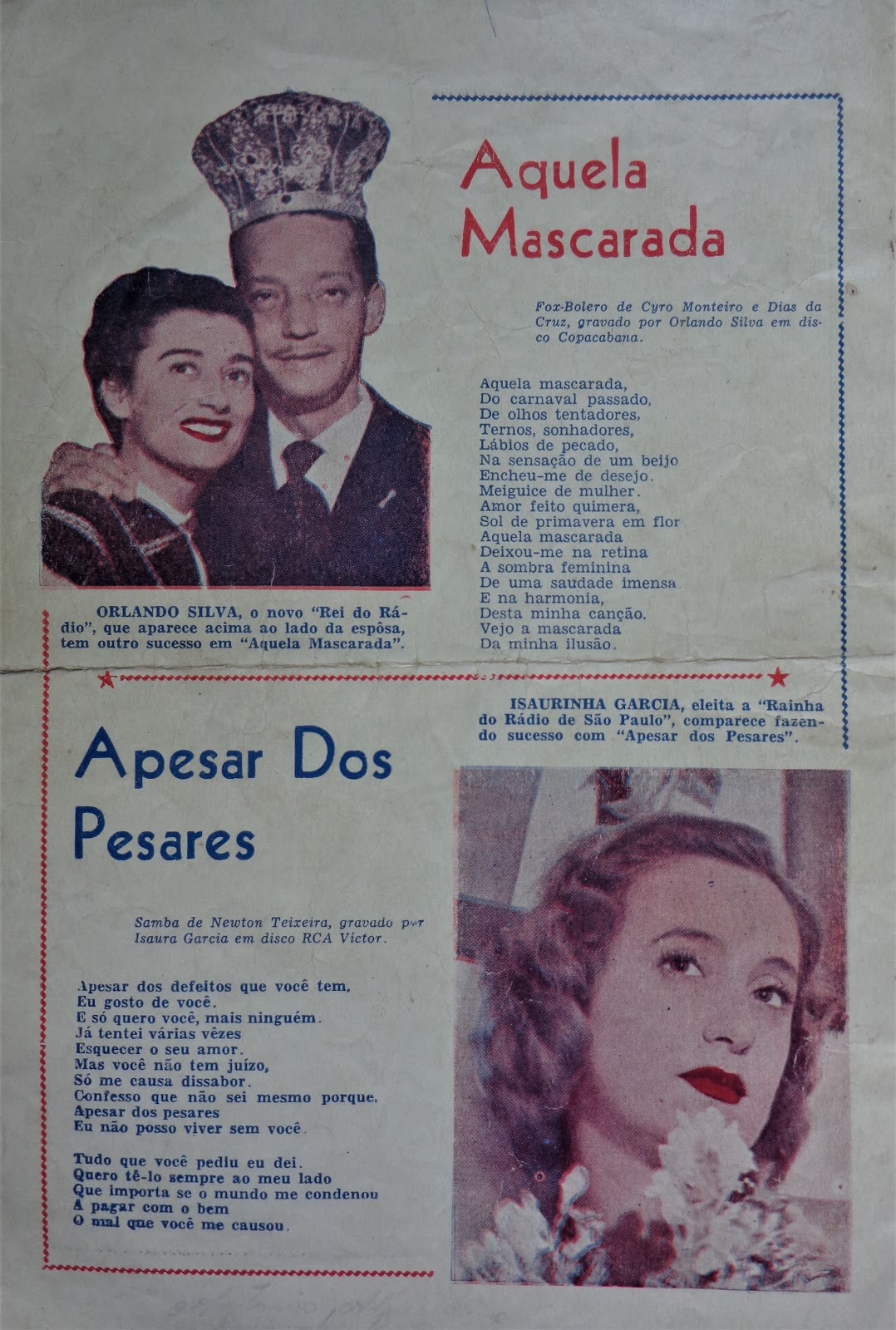
'Vamos Cantar' lyrics magazine from 1950 to 1958


December 1951, # 9 - Galhardo, Nelson, Blackout, Orlando & Chico Carlos; 
April 1952 - uncharacteristically 'Vamos Cantar' # 13, sports a drawing on its cover; Gregório Barrios on the back-cover. 
April 1952, # 13Nelson Gonçalves, Ernani Filho; Carmélia Alves, Luiz Gonzaga (Januário criou fama).
April 1952, # 13 - Francisco Alves in his last Carnaval (he would die in a car crash on 27 September 1952); Hebe Camargo in her first Carnaval (Sem tambor e sem corneta); Carlos Gardel, who had died on 24 June 1935.
April 1952, # 13 - Dick Farney; Carlos Galhardo (Se ela perguntar) & Bill Farr (Abraça-me)
April 1952, # 13Dalva de Oliveira still riding the crest of the wave that had made her the most popular female singer in the country since 1949; June 1952, # 15Linda Baptista, Dalva de Oliveira.
August 1952, # 17 - Marlene on the cover; Albertinho Fortuna & Jorge Goulart (Jezebel) on the back-cover.
August 1952, # 17 - Emilinha Borba, Luiz Gonzaga, Carmélia Alves & Olivinha Camargo (Coimbra).
December 1952, # 21 - Linda Baptista, Emilinha Borba; Joel & Gaúcho & Doris Monteiro with Mother.
June 1953, # 27 - São João songs with Orlando, Milóca, Linda & Francisco Carlos. 
August 1953, # 29Jorge Veiga, Milóca, Eva Garza & Gregório Barrios; Orlando Silva & Isaurinha Garcia.
August 1953, # 29 - Nora Ney (Bar da noite), 4 Azes & 1 Coringa; Doris Monteiro & Ivon Cury.
November 1953, # 32 - Marlene on the cover; Ivon Cury (Tristeza) & Vera Lúcia (Tão só) on the back-cover.
November 1953, # 32 - Trio de Ouro with Raul Sampaio, Lurdinha Bittencourt & Herivelto Martins; Orlando Correia (Sistema nervoso); El Cubanito (Golpecito) & Neuza Maria (Quisera).
November 1953, # 32 - 'Sistema nervoso', 'Cao, cao, mani picao', 'Risque', 'Lua nova' (Luna rossa)...
September 1954, # 42 - Nelson Gonçalves & Gregório Barrios; Lucio Alves (Valsa de uma cidade) & Dolores Duran (A canção da volta). 
September 1954, # 42 - Carmen Costa (Quase) & Bill Farr (Relógio sincopado/The syncopated clock).
September 1954, # 42Carlos Augusto (Cavaleiro errante), Carlos Galhardo with 'Pretenda', a wrong translation of 'Pretend'.
March 1955, # 48 - Nelson Gonçalves, Isaura Garcia, Milóca & Gregório Barrios; Dolores Duran (Carioca 1954). 
April 1955, # 49 - Angela Maria (Easter issue);  January 1958, # 58 - Marlene welcomes 1958!
April 1956, # 61 - Emilinha Borba with a stuffed Bunny celebrate Easter; Cauby Peixoto (Mambo do galinho) just before his manager Di Veras ordered him to have all his teeth removed and wear false teeth; Ivon Cury (Comida de pensão).
April 1956, # 61 - Black-Out (A vez do bôbo), Zezé Gonzaga (Amando em Paris).
July 1956, # 64 - Leny Eversong & friend at  # 64 - ; note how quaint the title 'Judeu errante' (Wandering Jew), a waltz written by Ayres Viana & Edel Ney sung by Alcides Gerardi.
September 1956, # 66 - Ivon Cury.
October 1956# 67 - Angela, Miloca & Marlene; 'Zefa cangaceira' (Dolores Duran).
March 1957, # 72 - Carnaval with Emilinha.
November 1957, # 80, Cauby, Angela, Maysa & Nelson; August 1958, # 89 - Lana Bittencourt. 
1958, # 91 - Cauby, Carlos José & Agnaldo Rayol; # 92 - Sylvia Telles & Emilinha Borba.

Sunday, 13 October 2019

NERINO SILVA

Nerino Silva was born in Rio de Janeiro-DF in 1920. He grew up in the slums in and around 'samba-schools' (escolas de samba) and learned how to dance the dance becoming an accomplished tap-dancer at an early age. On top of that he could also sing so he took his chances at gong shows so popular in the 1940s having won a round at Ary Barroso's top-rating radio-show in 1943, when he was 23 years old.

From gong-shows he was under contract with Radio Mauá where he would sing at 'Prata da casa' and various other programmes.

In 1955, Nerino was signed by Jayme Portela, the director of Escola de Samba Portela to sing and dance at shows touring Brazilian cities. When it was time to go back home, Nerino decided to stay in São Paulo, where he sang at night-clubs and social clubs. Soon, he was spotted by Diogo Mulero aka Palmeira, A&R (Artist & Repertoire) man at independent label Chantecler and recorded 'Não sou parafuso', a 78 rpm single for Carnaval.
Nerino Silva swings with the Esmeraldino Salles combo (regional). The whole band is shown below.
Luiz Machado (clarinet), Domingos Machado (guitar), Zequinha (caixa), Oswaldo Colagrande (accoustic guitar) & Esmeraldino Salles (double-bass).
27 November 1960 - 'O Estado de S.Paulo' night-life columnist Mary Wynne writes a note about Nerino Silva, o 'Escurinho das Candongas' being the star of a new show at Delval Bar, on Rua General Jardim. 
27 November 1960 - São Paulo had a vibrant nightlife in the 50s & early 60s. See Elza Laranjeira at La Vie en Rose on rua Major Sertório, 114, and Hugo Santana & Dorinha Duval at Michel on Major Sertório, 106. 
Nerino Silva shows Inezita Barroso & Cinderela a few secrets about playing the tambourine.
sensationalist Revista do Radio # 595 (4 February 1961) tells Nerino's sad story of alcoholism and degradation. 
Nerino Silva poses in front of his automobile and his first album for Chantecler in 1960 in São Paulo.
Nerino at Revista do Radio # 867 (30 April 1966) when he was signed by Continental Discos
Nerino & his brood... 5 children plus one... 
'Revista do Radio' n.620; 'Minha sogra' was Nerino's greatest hit in the 1st part of the 1960s.
Francisco Petronio tells Revista do Radio #714 (25 May 1963) how Nerino Silva helped him become a professional singer.

Friday, 11 January 2019

Whatever happened to MARY GONÇALVES?

1950s Brazilian singer Mary Gonçalves had a very interesting career. She started as a movie actress in the late 1940s, switched to a career as a recording artist in 1952. Then moved on to be one of the best night-club acts by the late 50s, touring Uruguay, Argentina, Chile, Colombia and Venezuela. By 1960, she knew she had to re-invent herself again. While singing in a night-club in Barranquilla, Mary met an American oil executive who lived in Colombia and got married. They ended up moving to Texas, where apparently Mary lived the rest of her life. No one known her date of death. 

Revista do Radio n. 566 - 23rd July 1960
3rd September 1961 - OESP columnist Mary Wynne chats with Mary Gonçalves at A Baiuca where had sung for many years... and tells Ms Wynne that even though she'd been in São Paulo for just a few weeks she'd already packed to go back to Barranquilla, Colombia, where she had been living since she married Gus Standish. As one can see, Mary didn't stay long in the city... she only stayed for a few days catching up with old friends but her mind was elsewhere... 
Revista do Radio n. 627 - 23rd September 1961
Revista do Radio n. 642 - 30 December 1961.
Revista do Radio n. 820 - 5 July 1965.

This is the last entry of Mary Gonçalves' name at 'Revista do Radio'. Times had changed so much in the last 3 years the columnist had to identify Mary as... 'the Brazilian singer Mary Gonçalves'... (who has been living in Caracas for some years - actually RR is wrong: Mary had been living in Colombia, not Venezuela) has returned to Brazil. No one knew how long Mary stayed, whether it was a short or a long stay. The fact is that Mary Gonçalves disappeared from the media altogether. She was living in the USA with her American husband by then and as Brazilian show business had changed radically by 1965, Mary was yesterday's news.

Friday, 19 October 2018

Angela Maria dies on 29 September 2018.


Angela Maria, 89, Brazilian singer who inspired a generation, dies

By Lis Moriconi
11 October 2018

Angela Maria, the Brazilian singer who became a national sensation in the 1950s and inspired a generation of artists with her piercing, sometimes hoarse, often melancholy voice, died on 29 September 2018, in São Paulo. She was 89.

Her husband, Daniel D’Angelo, announced the death in a video posted on her Facebook page.

Angela Maria had a wildly successful recording career and performed in sold-out halls well into her 80s, her voice still vibrant. She was equally at home performing tangos, cha-chas and boleros. She recorded more than 650 songs and appeared in 20 films.

She was also the subject of intense tabloid scrutiny. At a time when divorce was frowned upon in Brazil, she broke a cultural taboo by marrying four times, most controversially to Mr. D’Angelo, with whom she had moved in when she was 52 and he was 18.

She once explained the popularity of her music by noting that it drew on the heartache of Brazilians, a people well acquainted with hardship. But its appeal was universal.

“Everybody suffers,” she said in a television interview in 1988. “And this suffering is what I convey through the songs I sing.”

Unlike other radio stars of her era, she retained a strong following during the bossa nova and tropicália eras in the late 1950s and 1960s. She was still performing frequently when samba made a comeback in the ’70s and weathered changing styles into the ’90s.

“Angela came out of the Italian bel canto tradition and had Latin American influence, especially the bolero,” said Rodrigo Faour, who wrote a biography of her. “Her voice is powerful, it’s warm and mesmerizing, it’s not music you can put on in the background. And it had an ‘open sesame’ effect. Every time she sang, doors opened.”

She was born Abelim Maria da Cunha in Conceição de Macabu, Rio de Janeiro State, on 13 May 1929, the 10th child of Albertino Coutinho Cunha, a farmer who later became a Baptist pastor, and Julita Maria da Cunha. Because the family was very poor, Abelim spent part of her childhood living in other households, sometimes doing menial work.

Her talent was first spotted when she sang in churches as a teenager. Eager to sing for larger audiences, she would sneak out of services against the wishes of her family to compete in amateur radio competitions, which she entered under what would ultimately become her stage name. The competitions yielded prizes, which she stashed in a shoe box at home. She soon began entertaining the idea of recording an album.

As a young adult, she made a meager living working in a factory, where she dazzled colleagues by belting out semi-operatic songs like Gounod’s “Ave Maria.”

Angela Maria became an instant hit when radio stations began playing her first records in the early 1950s. By the end of the decade, having won numerous awards and become the country’s most well-paid singer, she began hosting live television shows. She maintained a punishing schedule, often shuttling between São Paulo and Rio de Janeiro.

Among her biggest hits were the rumba “Babalu” and the ballads "Labios de mel" ("Honey lips"), “Não Tenho Você” (“I Don’t Have You”) and “Vá, mas Volte” (“Leave, but Come Back”).


Her music had an impact on many prominent Brazilian musicians, including Milton Nascimento, Maria Bethânia and Djavan. The renowned singer Elis Regina said she had been “tremendously influenced” by Angela Maria.

The Brazilian singer and actress Carmen Miranda was also a fan. Angela Maria was startled to learn that Ms. Miranda — who was older and had became a luminary in Hollywood — was an avid collector of her albums.

Ms. Miranda contacted her to request a meeting 14 years after leaving Brazil. “She was my idol,” Angela Maria said. “When I heard she wanted to see me I froze.”

Along with Ms. Miranda and Dalva de Oliveira, Mr. Faour said, “Angela became the matrix of Brazilian singers.” He added, “She gave popular composers powerful, sophisticated renditions.”

Angela Maria married Mr. D’Angelo on her birthday in 2012, after they had been together for 33 years. In addition to him, she is survived by four children.

Angela Maria was sometimes chided for her over-the-top rendition of songs and her flashy dresses. She took the criticism as a compliment.

“It makes me proud,” she once said. “Brazilians are gaudy.”

A version of this article appears in print on Oct. 12, 2018, on Page B13 of the New York edition with the headline: Angela Maria, 89, Aching Voice of Brazil’s Melancholy.


Monday, 15 October 2018

Jeanette Adib, a very special journalist


from left to right: Jeanette Adib, Jair Alves, Linda Baptista, her sister Dircinha Baptista, unknown, Claudete Soares & singer Lucy Rosana. 
Lucio Alves, Armando Louzada, Célia Vilela, Jeanette Adib and Ademilde Fonseca chat about show business at a Rio de Janeiro restaurant. 'Jornal das Moças', 5 April 1956
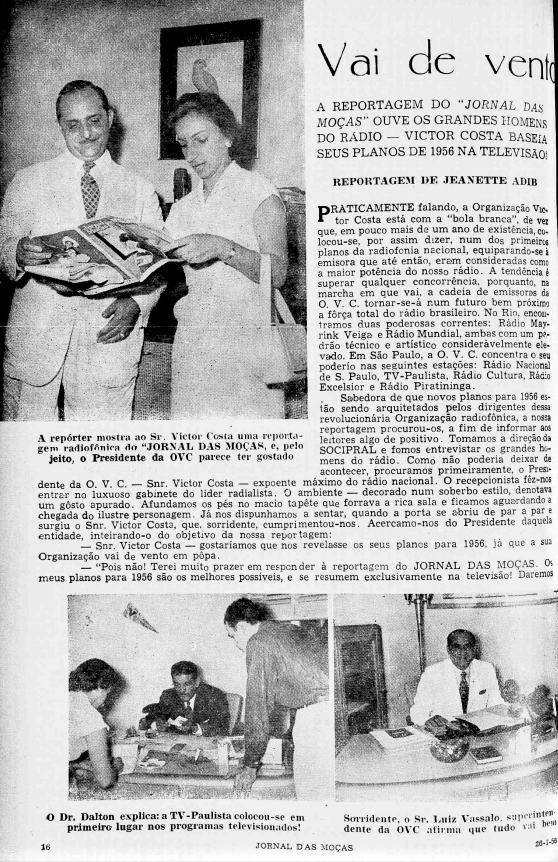
Jeanette Adib while working for 'Jornal das Moças', 26 January 1956; interviews Victor Costa, the man who managed to make Radio Nacional a powerhouse in the 30s & 40s. Mr Costa was given a network of radio & TV in the 1950s he properly named after himself, Organização Victor Costa (OVC). 
Jeanette Adib with impresario Abraham Medina (on the right of the photo) welcome US singer Connie Francis at Galeão Airport, when she flew from Rome, Italy where she had taken part at Festival di San Remo 1965

Jeanette Adib has also written a few popular songs during her heyday in the 50s & 60s

1. 'Tormento' (Ivan Paulo da Silva "Carioca"-Jeanette Adib) 78 rpm by Elizeth Cardoso - 1955
2. 'Mãos vazias' (Jeanette Adib) 78 rpm by Carmen Déa - 1956.
3. 'Seus carinhos' (Jeanette Adib) 78 rpm by Carminha Mascarenhas - 1958.
4. 'Dê o fora' (Roberto Carlos-Jeanette Adib) recorded by Wanderléa - 1964.
5. 'Eu não ligo, baby' (Ain't that better, baby?) Cheryl Lynn-Phil Medley; versão: Jeanette Adib; recorded by Meire Pavão for her Chantecler LP 'A rainha da juventude' - 1965.

6. 'Ouvindo o ring-a-ding(Hey Ring-A-Ding)  (Eddie Curtis; versão: Jeanette Adib) recorded by Meire Pavão for her LP 'A rainha da juventude' - 1965.
7. 'A loucura das garotas' (Paulinho Sette-Jeanette Adib) recorded at Continental by Cyro Aguiar - 1966. 
8. 'Receita para me conquistar' (Jeanette Adib-Aloísio) Cyro Aguiar's LP 'Inspiração' - 1967.